
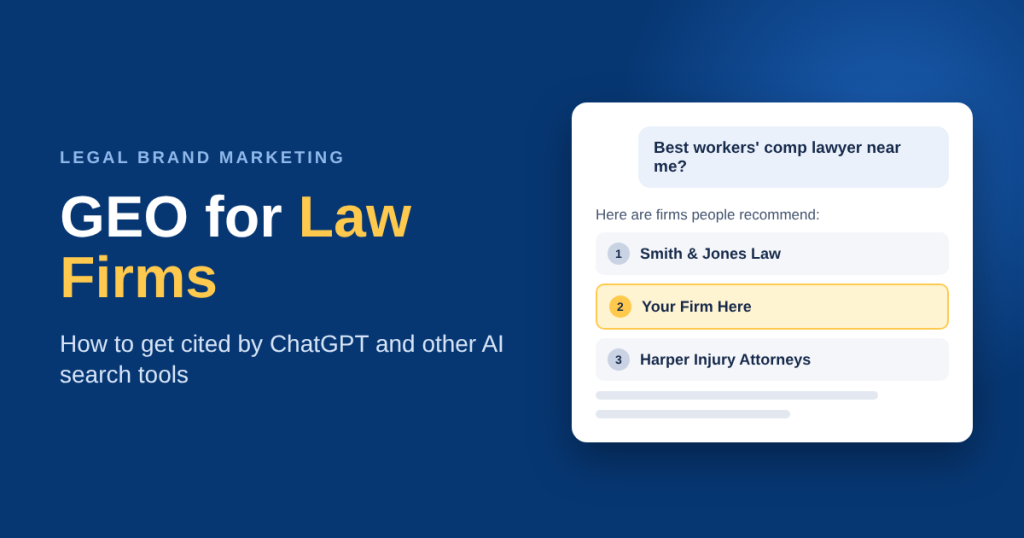
When Someone Asks ChatGPT for a Lawyer, Does Your Firm Come Up?
People still search Google for a lawyer. But more of them now ask an AI tool, read a short answer with a few names in it, and call one of those firms. If your firm isn’t in the answer, you may never see the click that would have come from a traditional search result.
This guide explains what generative engine optimization (GEO) is, what the research and Google’s own guidance say about it, and five practical steps a law firm can take this month. It also covers what to measure and how to evaluate anyone who offers to do GEO for you.
Where people are searching in 2026
Google still handles about 91% of worldwide search, according to StatCounter’s October 2026 data [1]. Cloudflare Radar, which measures referral traffic instead of page views, put Google at 89.04% of search referrals in the third quarter of 2026, and ChatGPT at 0.64% [2].
Those numbers make AI search look small. Two other findings show why it still matters.
First, AI summaries change what happens after a Google search. In Pew Research’s analysis of March 2025 browsing by 900 US adults, 18% of Google searches produced an AI summary. When a summary appeared, users clicked a traditional result link in 8% of visits. Without one, they clicked in 15% of visits. Only 1% of visits included a click on a link inside the summary itself [3].
Second, a small share of traffic can drive a larger share of discovery. In an August 2026 survey from NP Digital of 30 consumer businesses, ChatGPT accounted for 0.3% of search visibility but 6.8% of the places where customers first heard about the business. Google accounted for 91.2% of visibility and 45.2% of first discovery [4]. The sample is small and these are not law firms, so treat it as a direction, not a rule.
Put together: Google remains the main source of search traffic, and fewer of those searches turn into clicks. AI tools send little traffic today, but they can shape which firms a prospect remembers.
What GEO is, and what it is not
Generative engine optimization is the practice of making your content more likely to be used and cited in answers from AI search tools such as ChatGPT, Gemini, Perplexity and Google’s AI Overviews and AI Mode. The term comes from a 2023 research paper, accepted to KDD 2024, which reported that specific content changes could raise visibility in generative engine responses by up to 40%, and that results varied by subject area [5].
Google’s own documentation, last updated in July 2026, is more cautious. It says AI Overviews and AI Mode draw on Google’s core ranking and quality systems, so standard SEO still applies. It also says you do not need AI-specific markup or machine-readable files, that structured data is not required for generative AI features, that Google Search does not use llms.txt files, and that site owners should be skeptical of services claiming special access to Google’s systems [6].
What this means for a law firm: GEO is mostly good SEO and good reputation work, done carefully, with a way to check what AI tools say about you. No one can guarantee a citation, and results vary by tool and over time.
Five steps to get started
1. See what AI says about you today
Before changing anything, find out where you stand. Open ChatGPT, Gemini, Perplexity and Google’s AI Mode, and ask the questions your clients ask. Use a specific practice area and city, such as “best workers’ comp lawyer in Indianapolis.” Write down whether your firm appears, which firms do, and which sources the tool cites. Then run a direct check on your own firm:
I’m researching [Firm Name], a [practice area] law firm in [city or region]. Based on everything you know, what can you tell me about their reputation, client reviews, areas of practice, and notable results? Please list the specific sources you’re drawing from.
Run the same prompt for a competitor. The list of sources shows where AI tools look for information about firms like yours, and where a competitor is listed that you are not. Repeat the exercise monthly so you can see change over time.
2. Answer questions on your website in plain language
Build a page for each practice area and each city you serve, and write it from first-hand experience. State the direct answer first, then explain. Add an FAQ section made of real questions clients ask, such as how long a claim takes, what it costs, and what to do in the first week. Give each attorney a full bio with credentials, bar admissions and the areas they handle. Google’s guidance favors original, helpful, first-hand content over summaries of what others have already written [6].
3. Keep your listings identical everywhere
Your firm name, address and phone number should match across your Google Business Profile, Avvo, Martindale, FindLaw, your state bar listing and your own site. Google specifically points site owners to Google Business Profile for local business details [6]. Inconsistent listings make it harder for any search system to be confident about who you are.
4. Earn reviews and outside mentions
Ask satisfied clients for honest Google reviews, and make it easy by sending a direct link. Reviews that mention the practice area and city help readers and search systems understand what you do. Local press, bar association pages, community involvement and speaking engagements give AI tools more to draw on. Do not buy reviews or seek artificial mentions: Google states that seeking inauthentic web mentions isn’t helpful [6]. Check your state bar’s advertising rules before you ask for or publish reviews.
5. Make your site easy to crawl and read
Your pages need to be indexed and eligible to appear in Search with a snippet. Keep important content as real text, not text inside images or PDFs. Review your robots.txt file and any security or bot-blocking settings to confirm you are not blocking search crawlers by accident. Structured data (schema) is not required for AI features, but it is still worth adding for rich results, such as review stars and FAQ details, and it keeps your pages clear to any system reading them [6]. For a real-world example of what technical fixes and a content plan can do for a site, see our case study, 382% Keyword Growth in 9 Months.
How to measure progress
- Monthly prompt test. Keep a simple log of the questions you ask AI tools, whether your firm appears, and which sources are cited.
- Search Console. Google offers a Generative AI performance report in Search Console that shows how your pages appear in AI features [6].
- Intake question. Add “ChatGPT or another AI tool” as an option when you ask new clients how they found you. AI referrals often do not show up cleanly in analytics, so the client’s own answer is the best signal.
- Branded searches and calls. A rise in people searching your firm name, or calling after reading about you, is a useful indirect sign.
Mistakes to avoid
- Promises of guaranteed AI rankings. No one controls what an AI tool says. Results shift as tools change.
- Mass-producing pages. Google warns that creating large numbers of pages to manipulate rankings violates its scaled content abuse policy [6].
- Fake or incentivized reviews. They carry risk with the platforms and with your state bar.
- Chasing technical shortcuts. Google says you do not need special AI markup, and that its Search does not use llms.txt files [6].
- Ignoring the basics. A clear, accurate, well-maintained site with real reviews does more than any trick.
Questions to ask a GEO provider
Because the field is new and Google itself urges caution, it is worth vetting anyone who offers GEO services. Ask:
- What exactly will you change, and how will you show me the result?
- Do you work with law firms, and do you follow state bar advertising rules?
- How do you track whether my firm appears in AI answers, and how often?
- Do you guarantee citations or rankings? (A “yes” is a warning sign.)
- Will I own my content, listings and accounts if we stop working together?
Frequently asked questions
Is GEO different from SEO?
They overlap heavily. Google says AI Overviews and AI Mode use its core ranking and quality systems, so solid SEO still matters [6]. GEO adds attention to how AI tools describe your firm and which outside sources they rely on.
How long does it take to show up in AI answers?
There is no reliable timeline. Changes to your site, listings and reviews can take weeks or months to be reflected, and AI tools update at different speeds. Track monthly instead of expecting fast results.
Do I need a new website?
Usually not. Most firms can make progress by improving practice area pages, fixing listings, collecting reviews and checking technical access.
Can AI tools get my firm's information wrong?
Yes. That is why the monthly check matters. If an AI answer is wrong, correct the underlying sources, such as your own site and your directory listings.
Key Takeaways
Sources
- StatCounter, Search Engine Market Share Worldwide, October 2026
- TechnologyChecker.io, Search Engine Market Share Q3 2026 (citing Cloudflare Radar)
- Pew Research Center, Google users are less likely to click on links when an AI summary appears in the results, July 22, 2025
- NP Digital, Where Does Your Search Traffic and Revenue Come From Today?, via Neil Patel on Facebook, August 7, 2026
- Aggarwal et al., GEO: Generative Engine Optimization, KDD 2024 (arXiv:2311.09735)
- Google Search Central, Optimizing your website for generative AI features on Google Search (updated July 2026)